
Pure Desi Goodness Delivered Across Pakistan

Category: Uncategorized

  • How to Spot Real Desi Ghee in Pakistan: 3 Checks That Work

    How to Spot Real Desi Ghee in Pakistan: 3 Checks That Work

    August 24, 2026

    The most common adulterant in Pakistani desi ghee is vanaspati (hydrogenated vegetable fat), sometimes with palm oil. Both are a fraction of the cost of real ghee, and once blended in they are hard to see. Here is what you can actually check.

    The short answer

    Real desi ghee turns granular in cold weather and melts on your palm from body heat alone. Ghee that stays uniformly smooth all year, or sits solid on your skin without softening, is worth questioning.

    Neither is proof. The definitive test is the laboratory Baudouin test, which detects the sesame oil marker that vanaspati is required to contain. That is not something to attempt at home.

    Three checks you can do

    1. The palm test

    Put a small amount on your palm. Pure ghee starts melting almost immediately, because its melting point is close to body temperature. Vanaspati has a higher melting point and stays firm noticeably longer.

    2. The hot pan test

    Put a spoonful on a hot pan. Pure ghee melts fast, turns golden brown, and releases a strong nutty aroma within seconds. Adulterated ghee melts more slowly, stays pale yellow, and smells faint or oily.

    The aroma is the part to pay attention to. It is the hardest thing to fake.

    3. Watch it through winter

    This one takes patience but tells you the most. Real ghee separates into a granular, uneven texture as temperatures drop, because its different natural fats solidify at different points. Vanaspati behaves more uniformly, so blended ghee stays smoother.

    More on why ghee turns granular in winter

    What colour does not tell you

    Deep yellow ghee is widely believed to be purer. It is not. Real ghee is a light golden colour that shifts slightly with the season and the animal’s feed. Strong, consistent yellow is more often added colouring than a quality signal.

    The price maths

    Producing one kilogram of real desi ghee takes roughly 25 to 30 litres of milk. Work through current milk prices and you will see that ghee cannot be produced below a certain floor.

    If a 1kg jar is priced far below the market, something is filling the gap. Buying a jar that is 40% vanaspati at a 40% discount is not a saving — you have paid full price for the ghee and been given filler for the rest.

    Full breakdown of why ghee prices vary so widely in Pakistan

    Cow ghee or buffalo ghee?

    Cow ghee is lighter in colour with a milder flavour. Buffalo ghee is whiter and thicker because buffalo milk has more fat, which also makes it slightly cheaper to produce. Both are fine for everyday cooking. This is a preference, not a quality difference.

    Checks that need no tasting at all

    • Batch and packing date on the jar. Without it, nothing is traceable.
    • Glass, sealed. Loose ghee sold by weight has no record behind it.
    • A named source. “From our farms in [district]” is an answer. “Finest quality” is not.
    • An ingredient list. Desi ghee should have exactly one ingredient.

    Storing it properly

    Cool, dry place, out of sunlight. Do not refrigerate — it turns rock hard and becomes difficult to use.

    Always use a dry spoon. Moisture is what actually spoils ghee. Granularity is not spoilage; a sour smell or bitter taste is.

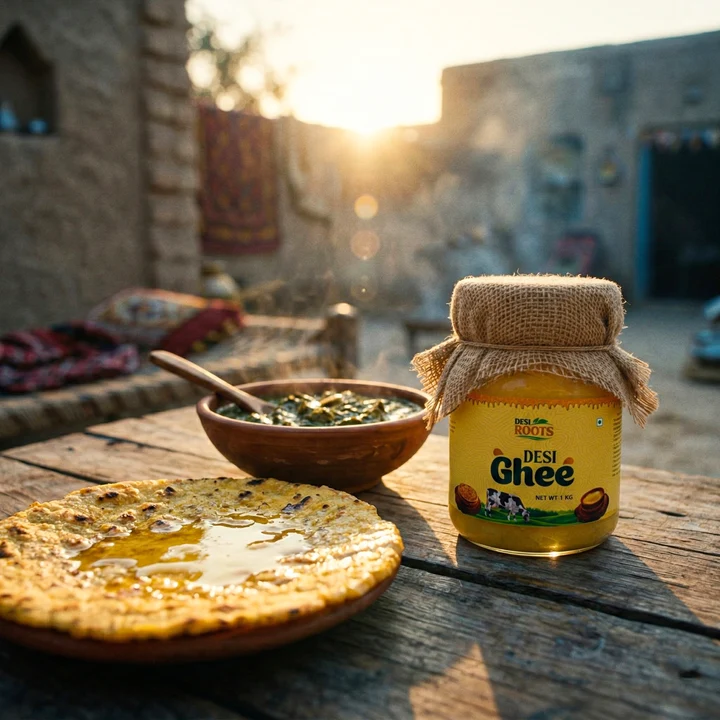
    Desi Roots desi ghee

    Made the traditional way over low heat, sealed in glass, with a batch and packing date on every jar. No vanaspati, no preservatives, no added colour. It turns granular in winter, which is what real ghee does.

    See our 1kg jar

    Frequently asked questions

    How can I tell if desi ghee has vanaspati in it?
    At home you cannot be certain. The palm test, hot pan aroma and winter granularity are useful indicators. Only a laboratory Baudouin test confirms it.

    Is deep yellow ghee purer?
    No. Real ghee is light golden and varies with season. Strong uniform yellow often indicates added colouring.

    Should desi ghee be refrigerated?
    No. A cool dry cupboard is enough. Refrigeration makes it unusably hard.

    Why does my ghee look grainy?
    Because it is real. Different natural fats in ghee solidify at different temperatures, producing that granular texture in cold weather.

    This is a food, not a medicine — we make no medical claims about it.
  • Talbina Recipe: How to Make It at Home (Without Lumps)

    August 24, 2026

    Talbina is a soft barley porridge. It takes about five minutes and needs one pan. The only step people get wrong is the first one — and that is what causes lumps.

    The short version

    1 tablespoon talbina to 1 cup liquid. Mix into COLD milk first, then heat. Simmer 4–5 minutes on low, stirring. Sweeten after taking it off the heat.

    Ingredients (1 serving)

    • 1 tablespoon talbina (about 15g)
    • 1 cup milk, cold — or water
    • Honey or sugar, to taste
    • Optional: chopped dates, almonds, pistachios

    Method

    1. Mix cold. Stir the talbina into cold milk in the pan until no dry powder remains. Do this off the heat.
    2. Heat gently. Put the pan on low. Never start on high.
    3. Stir for 4–5 minutes until it thickens to a pourable custard.
    4. Take it off the heat, then add honey or sugar.
    5. Top and serve with dates or nuts while warm.

    Why lumps form — and how to avoid them

    Adding the powder to hot milk cooks the outside of each particle instantly, sealing dry powder inside. That is a lump, and stirring will not undo it.

    Mixing into cold liquid first lets every particle hydrate evenly before any heat reaches it. This single change solves the problem completely.

    If lumps have already formed, a whisk or a stick blender will break them up.

    Getting the consistency right

    Talbina keeps thickening as it cools, so take it off slightly thinner than you want it.

    • Too thick? Add a splash of warm milk and stir.
    • Too thin? Another minute on low heat.
    • For children, use 1 tablespoon to 1.5 cups milk for a thinner result.

    Add honey after cooking, not before

    Boiling honey changes its flavour and destroys what makes raw honey worth buying. Sugar added early can settle and scorch on the base of the pan. Either way, sweeten at the end.

    Variations

    Cold talbina. Cook as normal, cool, then chill. Good in summer.

    With water. Works fine if you have no milk — lighter in flavour and thinner.

    Richer. Half milk, half cream, or stir in a teaspoon of desi ghee at the end.

    For more than one. The ratio scales directly: 4 tablespoons to 4 cups for four servings. Add 1–2 minutes to the cooking time.

    Plain barley powder vs real talbina

    A lot of what is sold as talbina is simply ground barley. Traditional talbina includes dried fruit and spices alongside the barley, and that is where the flavour comes from.

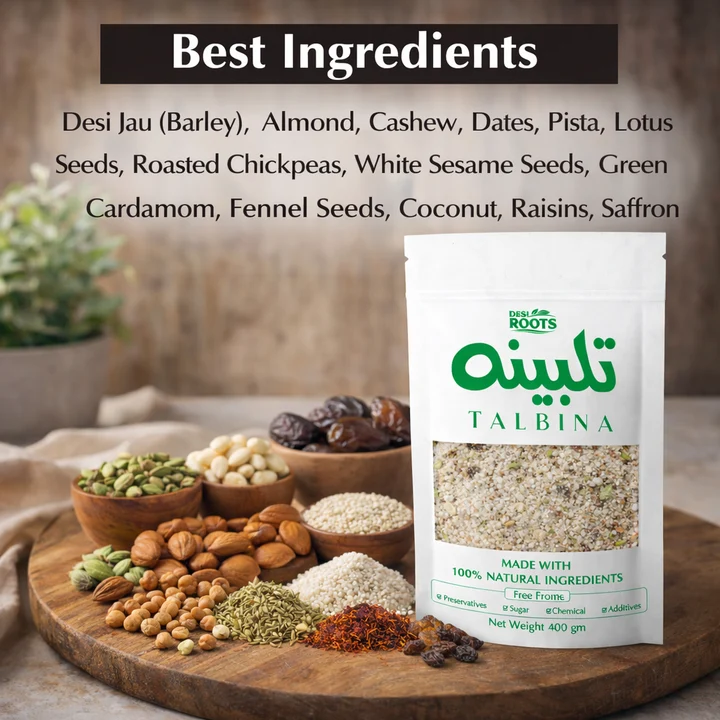
    If you have tried talbina before and found it bland, it was probably plain barley powder. Desi Roots talbina contains 15+ ingredients — barley, almonds, cashews, dates, pistachios, lotus seeds, roasted chickpeas, sesame, cardamom, fennel, coconut, raisins and saffron — so it needs nothing but sweetening.

    Storage

    Seal the pouch and keep it cool, dry and out of sunlight. Use it within a few weeks of opening — the dried fruit loses freshness over time. Always use a dry spoon.

    Cooked talbina is best made fresh. Leftovers thicken in the fridge; loosen with a little milk when reheating.

    See Desi Roots Talbina

    Frequently asked questions

    How much talbina per cup of milk?
    One tablespoon (about 15g) per cup. Use 1.5 cups for a thinner porridge.

    How do I stop talbina going lumpy?
    Mix it into cold milk before heating. Adding powder to hot milk is what creates lumps.

    How long does talbina take to cook?
    Four to five minutes on low heat, stirring.

    Can I make talbina with water instead of milk?
    Yes. It will be lighter and thinner but works.

    Can children eat talbina?
    Yes, it is an ordinary food. Make it thinner for young children.

    This is a food, not a medicine — we make no medical claims about it. Consult your doctor before changing your diet if you are managing a medical condition.
  • Talbina kya hai aur kaise banate hain? Poori guide

    August 26, 2026

    Talbina un chand ghizaon mein se hai jin ka naam sab ne suna hai lekin banane ka sahi tareeqa kam logon ko pata hai. Yeh guide us poore sawal ka jawab hai.

    Talbina kya hai?

    Talbina jau (barley) se bana aik narm daliya hai. Lafz talbina arabi ke laban se aaya hai, yani doodh — kyunki pak kar is ka rang aur texture doodh jaisa ho jata hai.

    Yeh Sunnah ghizaon mein shumaar hoti hai aur Pakistani gharon mein aaj bhi banai jati hai, khaas tor par sardiyon ke nashte mein.

    Ghar par kaise banayein

    Aik cup ke liye:

    1. Aik tablespoon talbina powder aik cup thande doodh ya paani mein mila lein.
    2. Halki aanch par rakhein aur 4 se 5 minute pakayein, halka sa hilate rahein.
    3. Gaadha ho jaye to aanch se utaar lein.
    4. Ab shehad ya cheeni apni pasand se daalein.
    5. Upar se khushk mewa daal kar garam pesh karein.

    Gaanth kyun ban jati hai?

    Sab se aam ghalti yeh hai ke powder garam doodh mein seedha daal diya jata hai. Is se bahar ka hissa foran pak jata hai aur andar ka sookha reh jata hai — gaanth ban jati hai.

    Hal aasan hai: hamesha thande doodh mein achi tarah mila lein, phir aanch par rakhein.

    Meethas kab daalein?

    Aanch se utaarne ke baad. Shehad ko ubalne se us ka zayeqa badal jata hai. Cheeni pehle daal dein to woh pakte waqt neeche baith kar jal sakti hai.

    Plain barley aur asli talbina mein farq

    Market mein bikne wali bohat si “talbina” asal mein sirf pisa hua jau hoti hai. Riwayati talbina mein jau ke saath khushk mewa aur masale bhi shaamil hote hain — badam, khajoor, ilaichi, saunf — aur yehi us ka zayeqa banate hain.

    Agar aap ne kabhi talbina try ki aur woh feeki lagi, to imkaan yehi hai ke woh sirf barley powder thi.

    Kitni der chalti hai?

    Pouch band rakhein, thandi khushk jagah par. Kholne ke baad chand hafton mein istemaal kar lein — khushk mewa waqt ke saath apni taazgi khota hai. Har dafa sukha chamach istemaal karein.

    Aksar poochhe jane wale sawal

    Bachon ko de sakte hain? Ji haan, yeh aik aam ghiza hai. Chhote bachon ke liye patla bana lein.

    Paani se bana sakte hain? Ji haan, doodh na ho to paani se bhi ban jati hai — zayeqa halka hoga.

    Raat ko bana kar rakh sakte hain? Behtar hai taaza banayein. Rakhi hui talbina gaadhi ho jati hai; garam karte waqt thora doodh mila lein.

    Yeh aik qudrati ghiza hai, dawa nahi. Hum is ke bare mein koi tibbi da’wa nahi karte. Kisi tibbi keyfiyat mein khoraak badalne se pehle apne doctor se mashwara karein.

  • Shehad jam gaya hai — kharab to nahi ho gaya?

    August 26, 2026

    Yeh sab se zyada poocha jane wala sawal hai jo hamein WhatsApp par milta hai. Jawab chhota hai: shehad kharab nahi hua. Yeh acha ishara hai.

    Aisa hota kyun hai?

    Raw shehad mein qudrati tor par glucose aur fructose dono hote hain. Thande mausam mein glucose alag ho kar chhote crystals ki shakal mein baith jata hai — aur shehad daanedaar mehsoos hone lagta hai.

    Yeh aik qudrati amal hai. Is se shehad ka zayeqa ya quality kharab nahi hoti.

    To phir kuch shehad kabhi kyun nahi jamta?

    Yahan asal baat hai. Jo shehad saara saal shishe jaisa saaf aur patla rehta hai, us ke aam tor par do mein se aik sabab hote hain:

    • Usay tez heat aur bareek filtering se guzara gaya hai — dekhne mein acha lagta hai, lekin us ka asli character khatam ho jata hai.
    • Ya us mein glucose syrup ya cheeni ka sharbat mila hua hai.

    Yani jamna kharabi ki nishani nahi — na jamna aksar shak ki baat hoti hai.

    Wapas patla kaise karein

    1. Aik bartan mein neim garam paani lein — ubalta hua nahi.
    2. Band jar ko us mein rakh dein.
    3. 10 se 15 minute chhor dein, beech mein aik do dafa hila lein.
    4. Zaroorat ho to paani badal lein.

    Yeh mat karein

    Microwave mein na rakhein. Yeh shehad ko na-barabar garam karta hai aur us ka zayeqa jala deta hai.

    Ubalte paani mein na daalein. Bohat zyada heat wahi cheezein khatam kar deti hai jin ki wajah se aap raw shehad khareedte hain — aur shishe ka jar bhi chatak sakta hai.

    Baar baar garam thanda na karein. Utna hi patla karein jitni zaroorat ho.

    Jamne se bachne ke liye

    Shehad ko fridge mein bilkul na rakhein — thandak jamne ko tez karti hai. Kamre ke darje-e-hararat par, dhoop se door rakhein.

    Aur sab se ahem: har dafa sukha chamach istemaal karein. Paani ki chand boondein bhi jar mein chali jayein to shehad kharab ho sakta hai — jamna is se kahin bara masla yeh hai.

    Kab shehad waqai kharab hota hai

    Sahi tareeqe se rakha gaya shehad barson chalta hai. Fikr sirf tab karein jab: khatti ya khameer wali bu aaye, jhaag nazar aaye, ya upar phaphoondi dikhe. Yeh aam tor par jar mein paani jane ki wajah se hota hai.

    Daanedaar hona in mein shaamil nahi.

    Ek saal se kam umar ke bachon ko shehad na dein. Yeh aik qudrati ghiza hai, dawa nahi — hum is ke bare mein koi tibbi da’wa nahi karte.

  • Desi ghee ka rate Pakistan mein itna mukhtalif kyun hota hai?

    August 26, 2026

    Aik hi cheez, aur rate Rs 1,800 se Rs 5,000 tak. Yeh sawal hamein har hafte milta hai, aur is ka jawab seedha hai: farq isliye hai kyunki har jar mein “desi ghee” ka matlab alag hota hai.

    Chhota jawab

    Aik kilo asli desi ghee banane ke liye taqreeban 25 se 30 litre doodh chahiye hota hai. Aaj Punjab mein doodh ka rate dekhein to sirf raw material ki lagat hi kaafi barh jati hai — phir usmein processing, jar, packing aur delivery shaamil karein.

    Is hisaab se agar koi 1kg desi ghee Rs 2,000 se kam mein de raha hai, to riyazi kaam nahi karti. Woh ghee ya to poora ghee nahi, ya us mein kuch aur mila hua hai.

    Rate barhane ya ghatane wali cheezein

    1. Doodh ka source

    Farm se barah-e-raast liya gaya doodh mehnga parta hai lekin us ka record hota hai. Mandi se mila hua mix doodh sasta hota hai lekin us ka koi ata pata nahi hota.

    2. Banane ka tareeqa

    Riwayati tareeqa — doodh se dahi, dahi se makhan, makhan ko halki aanch par ghee — waqt leta hai aur output kam deta hai. Industrial method tez hai aur zyada deta hai, lekin us tez heat se zayeqa aur khushbu dono halke par jate hain.

    3. Milawat

    Yahi asal wajah hai jis se rate itna gir jata hai. Sab se aam milawat vanaspati (banaspati) aur palm oil hai. Yeh dono desi ghee se kai guna saste hain, aur milane ke baad dekhne mein farq karna mushkil hota hai.

    4. Packing

    Shishe ka sealed jar plastic ki thaili se mehnga hai. Lekin khuli ya patli plastic packing mein ghee ki khushbu jaldi urhti hai aur us ka koi batch record nahi hota.

    5. Delivery

    Free nationwide delivery kisi ke liye bhi free nahi hoti — woh kahin na kahin rate mein shaamil hoti hai. Rate compare karte waqt yeh dekhein ke delivery alag se lag rahi hai ya nahi.

    Sasta ghee actually kitna sasta hai?

    Farz karein aap Rs 1,900 wala 1kg jar lete hain aur us mein 40% vanaspati mili hui hai. Aap ne 600 gram ghee ke liye Rs 1,900 diye — yani asal rate Rs 3,166 per kg pare. Aur baaki 400 gram woh cheez hai jo aap ne kabhi khareedni hi nahi chahi thi.

    Is nazar se dekhein to sasta ghee aksar mehnga sauda hota hai.

    Rate ke ilawa kya dekhein

    • Jar par batch aur packing date hai? Na ho to source ka koi record nahi.
    • Brand source bata sakta hai? “100% pure” har koi likhta hai. Poochein ke kis ilaqe se aata hai.
    • Sardi mein daanedaar hota hai? Asli ghee thande mausam mein jam kar granular ho jata hai. Saara saal aik jaisa chikna rehna shak ki baat hai.
    • Rang gehra peela hai? Yeh purity ki nishani nahi — aksar artificial colour ki nishani hoti hai.
    • Khushbu kaisi hai? Tez aur nutty honi chahiye, plastic jaisi nahi.

    Desi Roots ka rate kyun jo hai wohi hai

    Hamara 1kg jar Rs 3,200 ka hai, free delivery ke saath. Yeh rate riwayati tareeqe, sealed glass jar, aur har jar par batch date ka rate hai. Hum is se neeche is liye nahi jaate ke us ke liye in teenon mein se kisi aik par samjhota karna parta.

    Desi Ghee collection dekhein

    Aksar poochhe jane wale sawal

    Pakistan mein 1kg desi ghee ka munasib rate kya hai?
    Asli desi ghee aam tor par Rs 2,800 se Rs 4,500 per kg ke darmiyan milta hai, brand aur packing ke hisaab se. Is se kaafi kam rate par milawat ka imkaan barh jata hai.

    Gaaye aur bhains ke ghee ka rate alag kyun hai?
    Bhains ke doodh mein fat zyada hota hai, is liye us se ghee ki output behtar aati hai — rate aksar thora kam hota hai. Rozana cooking ke liye dono theek hain.

    Bara jar lene se sasta parta hai?
    Aam tor par per-kg rate thora behtar ho jata hai. Lekin agar aap pehli dafa le rahe hain to chhota size lein aur pehle zayeqa dekh lein.

    Yeh qudrati ghizaein hain, dawaein nahi — hum in ke bare mein koi tibbi da’wa nahi karte.

  • Talbina, Oats aur Dalia mein kya farq hai?

    August 26, 2026

    Teenon nashte ke liye istemaal hote hain aur teenon anaaj se bante hain — lekin yeh aik cheez nahi hain. Neeche seedha farq hai.

    Chhota jawab

    • Dalia — gandum (wheat) ko tor kar banaya jata hai. Motta texture, halka zayeqa.
    • Oats — jai (oat) ke daane ko dabaa kar flakes banaye jate hain. Zyada tar imported.
    • Talbina — jau (barley) se banti hai, bareek pisi hui, aur riwayati tor par khushk mewa aur masalon ke saath.

    Yani teenon ka anaaj hi alag hai: gandum, jai, aur jau.

    Texture ka farq

    Dalia pak kar bhi daanedaar rehta hai — chabana parta hai. Oats narm ho jate hain lekin flakes alag alag mehsoos hote hain. Talbina bareek pisi hui hoti hai, is liye woh bilkul narm aur creamy ban jati hai — lagbhag custard jaisi.

    Isi wajah se talbina chhote bachon aur buzurgon ke liye asaan rehti hai, aur bimari ke baad jab kuch bhaari na khaya ja sake tab bhi.

    Zayeqa

    Plain dalia aur plain oats dono feeke hote hain — upar se kuch daalna hi parta hai. Riwayati talbina mein khushk mewa aur masale pehle se shaamil hote hain: badam, khajoor, pista, ilaichi, saunf, zafran. Is liye woh apne aap mein poori hoti hai.

    Yahan aik zaroori baat: market mein bikne wali bohat si “talbina” asal mein sirf pisa hua jau hoti hai. Agar aap ne kabhi talbina try ki aur woh feeki lagi, to zyada imkaan hai ke woh plain barley powder thi.

    Kaun kis ke liye

    AnaajTextureBehtar kab
    DaliaGandumMotta, daanedaarBhaari nashta chahiye
    OatsJaiFlakes, narmJaldi ban jaye, 2 minute
    TalbinaJauBilkul narm, creamyBachay, buzurg, sardi ka nashta

    Banane ka waqt

    Oats sab se tez — 2 se 3 minute. Talbina 4 se 5 minute halki aanch par. Dalia sab se zyada waqt leta hai, aur usay pehle bhigona bhi parta hai.

    Sunnah ka pehlu

    Yahan Talbina alag hai. Woh Sunnah ghizaon mein shumaar hoti hai aur Pakistani gharon mein sadiyon se banti aa rahi hai. Dalia aur oats ke saath yeh riwayati ta’alluq nahi hai. Bohat se gharon ke liye yeh wajah khud ahem hoti hai.

    To kya chunein?

    Yeh muqabla nahi hai — teenon apni jagah theek hain. Lekin agar aap chahte hain ke nashta narm ho, apne aap mein poora ho, aur us mein khushk mewa pehle se ho, to talbina wohi cheez hai.

    Desi Roots Talbina dekhein — 15+ ajza ke saath

    Aksar poochhe jane wale sawal

    Kya talbina aur dalia aik hi cheez hai?
    Nahi. Talbina jau (barley) se banti hai, dalia gandum se. Anaaj alag hai aur texture bhi.

    Kya oats ki jagah talbina le sakte hain?
    Ji haan, nashte mein dono aik hi jagah leti hain. Talbina zyada narm hoti hai aur riwayati talbina mein zayeqa pehle se hota hai.

    Kaunsi jaldi banti hai?
    Oats sab se tez (2–3 minute). Talbina 4–5 minute. Dalia sab se zyada waqt leta hai.

    Kya talbina rozana kha sakte hain?
    Ji haan, yeh aik aam ghiza hai jo rozana nashte mein li ja sakti hai.

    Yeh qudrati ghizaein hain, dawaein nahi — hum in ke bare mein koi tibbi da’wa nahi karte. Kisi tibbi keyfiyat mein khoraak badalne se pehle apne doctor se mashwara karein.

  • Asli Shilajit kaise pehchanein? 4 ghar ke test

    August 26, 2026

    Shilajit ki maang barhi to market mein naqli maal bhi barh gaya. Neeche chaar aisi cheezein hain jo aap ghar par khud dekh sakte hain — aur do ehtiyatein jo bohat ahem hain.

    Chhota jawab

    Asli shilajit resin neim garam paani mein poori tarah ghul jata hai, koi reit ya na-ghulne wala hissa nahi chhorta. Sardi mein sakht ho jata hai, garmi mein narm — aur us ki bu mitti aur dhuen jaisi hoti hai, meethi nahi.

    1. Paani wala test

    Chawal ke daane ke barabar hissa lein aur usay neim garam paani mein daal dein. Kuch minute mein woh poori tarah ghul jana chahiye aur paani ka rang gehra bhoora ya kaala ho jana chahiye.

    Agar tale mein reit, powder, ya koi na-ghulne wala hissa baith jaye — to us mein milawat hai.

    Ubalta paani na istemaal karein

    Yeh sirf test ke liye nahi, rozana istemaal ke liye bhi. Bohat zyada heat resin ko kharab kar deti hai. Neim garam se murad woh paani hai jismein ungli daali ja sake.

    2. Mausam ke saath badalta hai

    Asli resin sardi mein sakht ho jata hai — itna ke chamach mushkil se lage. Garmi mein woh narm aur chipchipa ho jata hai.

    Jo “shilajit” saara saal bilkul aik jaisa rehta hai, us mein aksar kuch aur mila hota hai.

    3. Bu aur zayeqa

    Asli shilajit ki bu mitti aur dhuen jaisi hoti hai, aur zayeqa kaafi karwa hota hai. Yeh khaane mein khushgawar cheez nahi hai — aur usay khushgawar hona bhi nahi chahiye.

    Agar aap ka shilajit meetha lage ya us mein coffee ya chocolate jaisi bu ho, to shak karein.

    4. Packing aur record

    Yeh test nahi, lekin sab se ahem nishani hai. Dekhein ke:

    • Jar par batch aur packing date hai ya nahi
    • Brand ilaqa bata sakta hai ya nahi (masalan Gilgit Baltistan)
    • Jar sealed hai ya khula

    “Himalayan” ya “100% pure” likhna aasan hai. Batch date likhna us se mushkil hai.

    Jo test kaam nahi karte

    Internet par kuch “flame test” aur “chipkane wale test” ghoomte hain. Yeh qabil-e-bharosa nahi — in se aap ko sirf yeh pata chalta hai ke cheez jalti hai ya nahi, yeh nahi ke us mein kya mila hai. Poori tasveer dekhein: source, packing, batch record, aur paani wala test.

    Istemaal ka tareeqa

    Chawal ke daane ke barabar chhota hissa neim garam paani ya doodh mein ghol lein. Rozana aik martaba se zyada nahi. Zyada lena behtar nahi hai.

    Zaroori ehtiyat — zaroor parhein

    Shilajit aik riwayati qudrati mahsool hai, dawa nahi. Hum is ke bare mein koi tibbi da’wa nahi karte aur na hi yeh kisi bimari ke ilaj, tashkhees ya bachao ke liye hai.

    Shilajit har kisi ke liye munasib nahi. Agar aap hamila hain, doodh pila rahi hain, umar 18 saal se kam hai, ya koi dawa le rahe hain — to istemaal se pehle apne doctor se zaroor mashwara karein.

    Desi Roots Gilgati Shilajit dekhein — pehli baar le rahe hain to 10g starter pack se shuru karein.

    Aksar poochhe jane wale sawal

    Shilajit sakht ho gaya hai, kharab to nahi?
    Nahi. Sardi mein sakht hona normal hai. Jar ko chand minute neim garam paani mein rakhein.

    Kitni miqdar leni chahiye?
    Chawal ke daane ke barabar, rozana aik dafa. Is se zyada nahi.

    Resin behtar hai ya powder?
    Resin apni asli shakal ke qareeb hota hai. Powder aur capsules mein doosri cheezein milana asaan hota hai.

    Kahan rakhein?
    Thandi khushk jagah, dhoop se door. Fridge ki zaroorat nahi.

  • Sunnah Foods: 7 ghizaein jo aaj bhi Pakistani gharon mein hain

    August 26, 2026

    Sunnah ghizaein woh khane hain jin ka zikr riwayat mein milta hai aur jo aaj bhi Pakistani gharon ka hissa hain. Yeh koi mushkil ya naayab cheezein nahi — zyada tar aap ke kitchen mein pehle se maujood hain.

    1. Shehad

    Sab se zyada mashhoor. Pakistan mein Sidr (beri), acacia (kikar) aur jungle ka shehad aam milta hai. Raw shehad sardi mein qudrati tor par jam kar daanedaar ho jata hai — yeh purity ki nishani hai, kharabi ki nahi.

    Aik saal se kam umar ke bachon ko shehad na dein.

    2. Khajoor

    Ramzan mein har ghar mein, lekin saal bhar bhi khayi ja sakti hai. Ajwa, Ajwa se sasti Mabroom, aur aam Iraqi khajoor Pakistan mein asani se mil jati hain. Doodh ke saath ya seedha.

    3. Jau (Barley) — aur Talbina

    Jau se banne wali Talbina shayad sab se kam samjhi jane wali Sunnah ghiza hai. Yeh jau ka bareek daliya hai jo pak kar bilkul narm aur creamy ho jata hai.

    Riwayati talbina mein sirf jau nahi — us ke saath khushk mewa aur masale bhi shaamil hote hain. Talbina banane ka poora tareeqa yahan hai.

    4. Zaitoon ka tel

    Khane mein aur lagane dono mein. Pakistan mein zyada tar imported milta hai, lekin ab Balochistan aur Potohar mein maqami zaitoon ki kasht bhi barh rahi hai.

    5. Kalonji (Black Seed)

    Chhote kaale daane jo har pansaar ke paas milte hain. Shehad ke saath, ya naan aur roti par chhirak kar.

    6. Doodh aur us se banne wali cheezein

    Doodh, dahi, makhan aur desi ghee — chaaron riwayati Pakistani khane ki bunyad hain. Asli desi ghee sardi mein daanedaar ho jata hai, jo aik acha ishara hai.

    7. Jau ki roti aur sattu

    Gandum se pehle Punjab mein jau aam thi. Aaj bhi dehaat mein jau ki roti aur garmiyon mein sattu ka sharbat banta hai.

    In ko rozana mein kaise laayein

    Sab kuch aik saath badalne ki zaroorat nahi. Sab se asaan shuruat:

    • Nashte mein aik cup talbina — 5 minute lagte hain
    • Chai ya neim garam paani mein cheeni ki jagah shehad
    • Paratha ya daal par aik chamach desi ghee
    • Sham ki chai ke saath do khajoorein

    Ek zaroori baat

    Yeh ghizaein hain, dawaein nahi. Riwayat mein in ka zikr un ki ahmiyat batata hai, lekin hum in ke bare mein koi tibbi da’wa nahi karte — na yeh kisi bimari ka ilaj hain, na us se bachao ka zariya. Kisi tibbi keyfiyat mein khoraak badalne se pehle apne doctor se mashwara karein.

    Aur aik cheez jo hum riwayat se seekh sakte hain: asli aur saada khana. Milawat wala shehad ya vanaspati mila ghee is riwayat ka hissa nahi hai.

    Desi Roots ki poori range dekhein

    Aksar poochhe jane wale sawal

    Sunnah foods kya hain?
    Woh khane jin ka zikr Islami riwayat mein milta hai — jaise shehad, khajoor, jau, zaitoon aur kalonji. Yeh aam ghizaein hain jo aaj bhi Pakistani gharon mein istemaal hoti hain.

    Kya Talbina Sunnah food hai?
    Ji haan. Talbina jau se banti hai aur us ka zikr riwayat mein milta hai.

    Yeh Pakistan mein kahan milte hain?
    Zyada tar cheezein aam pansaar aur kirane ki dukan par mil jati hain. Shehad, ghee aur talbina jaisi cheezon mein source aur packing dekhna zaroori hai.

  • Sardiyon mein desi ghee jam jata hai — kharab to nahi hua?

    August 26, 2026

    Sardi aati hai aur jar mein ghee daanedaar ho jata hai. Har saal yeh sawal aata hai: kya yeh kharab ho gaya?

    Chhota jawab

    Nahi. Yeh acha ishara hai. Asli desi ghee thande mausam mein qudrati tor par jam kar granular ho jata hai. Jo ghee saara saal bilkul aik jaisa chikna rehta hai, us mein aksar vanaspati mili hoti hai.

    Aisa hota kyun hai?

    Ghee mein mukhtalif qism ki qudrati fats hoti hain, aur har aik alag darje-e-hararat par jamti hai. Jab kamre ka temperature girta hai to kuch fats pehle jamti hain aur kuch baad mein — isi wajah se woh daanedaar (granular) shakal banti hai.

    Vanaspati aur palm oil ka behaviour is se alag hota hai. Woh zyada aik jaisa rehta hai. Isi liye jis ghee mein woh mila ho, woh sardi mein bhi utna nahi badalta.

    Rang bhi badal jata hai

    Garmi mein pighal kar ghee saaf sunehra ho jata hai. Sardi mein jam kar woh halka aur zyada opaque lagta hai. Dono halatein normal hain — yeh aik hi ghee ki do shaklein hain.

    Aur yaad rakhein: gehra peela rang purity ki nishani nahi hai. Woh aksar artificial colour ki nishani hoti hai.

    Jame hue ghee ko istemaal kaise karein

    Aam tor par kuch karne ki zaroorat hi nahi — garam tawe ya handi par rakhte hi woh pighal jata hai.

    Agar chamach lagana mushkil ho to jar ko chand minute neim garam paani mein rakh dein. Poora jar baar baar pighla kar dobara jamana theek nahi — utna hi narm karein jitni zaroorat ho.

    Fridge mein rakhein ya nahi?

    Nahi. Desi ghee ko fridge ki zaroorat nahi hai. Fridge mein woh patthar ki tarah sakht ho jata hai aur har dafa nikalna mushkil ho jata hai.

    Thandi khushk jagah, dhoop se door — bas itna kaafi hai.

    Asal khatra jamna nahi — paani hai

    Ghee kharab hone ki sab se bari wajah namee hoti hai. Geela chamach jar mein daalne se paani ki chand boondein chali jati hain, aur wahin se kharabi shuru hoti hai.

    Is liye hamesha sukha chamach istemaal karein. Yeh aik chhoti aadat hai jo jar ki umar kai mahine barha deti hai.

    Ghee waqai kab kharab hota hai

    Fikr sirf tab karein jab: khatti ya baasi bu aaye, zayeqa karwa lage, ya upar phaphoondi nazar aaye. Yeh aam tor par paani jane ki wajah se hota hai, mausam ki wajah se nahi.

    Daanedaar hona in mein shaamil nahi.

    Desi Roots Pure Desi Ghee dekhein — riwayati tareeqe se halki aanch par tayyar, sealed glass jar mein.

    Aksar poochhe jane wale sawal

    Sardi mein desi ghee jamna normal hai?
    Ji haan, bilkul. Yeh asli ghee ki nishani hai. Vanaspati mila ghee itna nahi jamta.

    Ghee ko fridge mein rakhna chahiye?
    Nahi. Thandi khushk jagah kaafi hai.

    Jama hua ghee pighla kar dobara rakh sakte hain?
    Aik dafa theek hai, lekin baar baar pighlana aur jamana behtar nahi. Sirf zaroorat ke mutabiq narm karein.

    Ghee kitna arsa chalta hai?
    Sahi tareeqe se rakha gaya ghee kai mahine chalta hai. Sukha chamach istemaal karna sab se ahem cheez hai.

    Yeh aik qudrati ghiza hai, dawa nahi — hum is ke bare mein koi tibbi da’wa nahi karte.

  • How to Make a Crispy Desi Ghee Paratha at Home

    October 27, 2026

    How to Make a Crispy Desi Ghee Paratha at Home

    A crispy, flaky paratha is a favourite breakfast choice in many Pakistani households. Served with chai, yogurt, omelette or a simple cup of milk, a freshly cooked paratha brings traditional flavour to the breakfast table.

    One ingredient that gives paratha its distinctive taste and aroma is desi ghee. If you want to prepare a homemade desi ghee paratha, this easy recipe will guide you through the ingredients, preparation and cooking process.

    Ingredients for Desi Ghee Paratha

    You will need:

    • 2 cups whole wheat flour (atta)
    • Approximately ¾ cup water, added gradually
    • ½ teaspoon salt, or to taste
    • 2–3 tablespoons desi ghee, as needed
    • A little extra flour for rolling

    The amount of water may vary depending on the flour you use.

    Step 1: Prepare the Dough

    Add whole wheat flour and salt to a mixing bowl. Gradually add water and knead until a soft, smooth dough forms.

    Cover the dough and let it rest for 15–20 minutes. Resting helps the dough become easier to roll and handle.

    Step 2: Roll the Paratha

    Divide the dough into equal-sized balls. Roll one ball into a thin circle using a rolling pin.

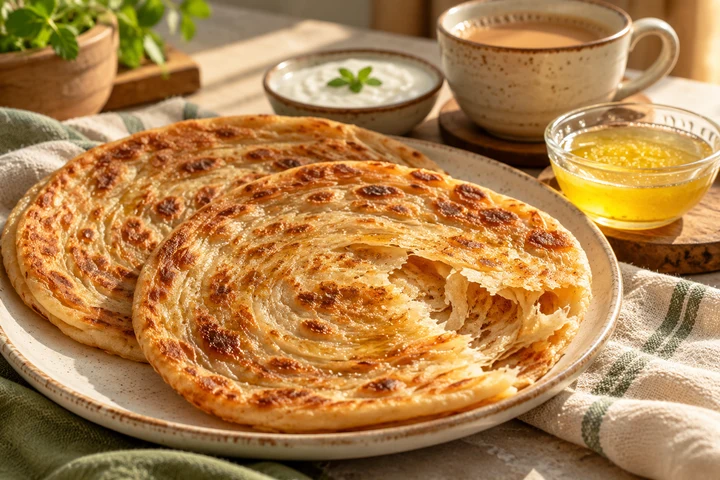
    Spread a thin layer of desi ghee over the surface. Fold the dough into layers or roll it into a spiral to create the flaky texture commonly associated with layered parathas.

    Dust lightly with flour and roll again without pressing too hard.

    Step 3: Cook with Desi Ghee

    Heat a tawa or flat pan over medium heat. Place the rolled paratha on the hot surface and cook until small bubbles appear.

    Flip it over and spread a little desi ghee on the cooked side. Flip again and apply a small amount of ghee to the other side.

    Cook both sides until golden spots appear and the paratha becomes crisp. Adjust the heat as needed to ensure the inside cooks properly without burning the outside.

    Tips for a Crispy and Flaky Paratha

    Use soft dough: Dough that is too dry can make the paratha tough.

    Allow resting time: Resting makes the dough easier to roll.

    Create layers: Spreading ghee between folds helps create a flaky texture.

    Avoid excessive heat: Very high heat may brown the outside before the inside is properly cooked.

    Serve fresh: Parathas generally taste best when served hot and freshly prepared.

    Desi Ghee vs Other Cooking Fats for Paratha

    Desi ghee is traditionally used in many Pakistani kitchens for its rich flavour and aroma. Other cooking fats can also be used, depending on personal preference and dietary requirements.

    The best choice depends on your cooking needs, taste preferences and overall dietary pattern. Remember that ghee is rich in saturated fat, so portion size matters.

    What Should You Look for When Buying Desi Ghee?

    When choosing desi ghee for everyday cooking, consider the following:

    • Check the ingredient list and product description.
    • Look for clear manufacturer and packaging information.
    • Review available quality documentation and applicable food-safety certifications.
    • Choose packaging that is properly sealed and labelled.
    • Follow the storage instructions provided on the product.

    Colour, aroma and texture alone cannot reliably establish whether a product is pure. Look for credible quality information rather than relying only on traditional home tests.

    Enjoy Traditional Flavour with Desi Roots

    A homemade paratha is a simple way to bring traditional Pakistani flavours to your breakfast table. With a few basic ingredients and the right cooking technique, you can prepare a golden, flaky paratha in your own kitchen.

    If you are looking for desi ghee for your everyday cooking, explore the Desi Roots Desi Ghee collection and review the available product details before choosing the right pack for your household.

    Make your next breakfast a little more traditional with Desi Roots.